
SESSA QI Day · 26 Nov Abstracts due 23rd October (extended)

SQuARes Net


SESSA Quality Improvement, Audit and Research Network

Your local Trainee Research Network — support, contacts and advice for QI, audit and research, and SESSA's link into UK-wide trainee-led projects.

SESSA's Trainee Research Network Affiliated UK-wide TRN federation member: RAFT Annual SESSA QI Day

Current projects

Anaesthetics & ICU

Anaesthetics

ICU

Projects needing a trainee

Pick one up, or take one over as others rotate

Annual SESSA QI Day

Showcasing trainee work each autumn
SESSA QI Day 2026 — Momentum
2026 — "Momentum"

26th November, 9:00–16:00 · Paderewski Lecture Theatre, Western General Hospital

A day dedicated to building and sustaining quality improvement across anaesthetics and beyond — free to attend, and open to resident doctors, SAS doctors, medical students, AHPs and consultants alike.

What the day looks like

  • Expert speakers sharing real stories of change — what worked, what didn't, and how to keep momentum going
  • Trainee oral presentations and a poster session, with cash prizes on offer
  • Abstracts welcome on any audit or QI project, whatever the size
  • Social afterwards at The Raeburn, Stockbridge
Register to attend Submit an abstract Programme — coming soon Abstract deadline extended: 23rd October

How we can help

Pick whatever's useful — in any order

There's no set route through SQuARes Net. Use one of these, several, or all of them — whatever fits where you are with your project (or whether you have one yet).

Ask

Get advice

Questions about QI, audit or research methodology, approvals or who to speak to? Drop us a line and we'll point you in the right direction.

Join

Find a project

Join one already running in anaesthetics or ICU, pick up one needing a trainee, or bring an idea of your own.

Continue

Keep it going

Rotating soon? We can help hand a project on — or find you one to take over — so good work doesn't stall.

Share

Present your work

Showcase any QI or audit at the annual SESSA QI Day, whether or not it started with us.

Events & Courses

Across Scotland, beyond our QI Day

Coming up

Course · Edinburgh

Edinburgh Critical Care Research Methods Course

Thursday 8th – Friday 9th October 2026 · Usher Building, Edinburgh BioQuarter

A two-day course of lectures and interactive workshops, directed by Professors Nazir Lone and Tim Walsh, covering the methods you need to critically appraise and conduct clinical research in acute care — statistics, trials, epidemiology, systematic reviews, health economics, diagnostic tests and QI science. Aimed at clinicians, trainees, AHPs and researchers in critical care, anaesthesia, emergency and acute medicine.
£295 · 10 RCoA CPD credits

New · Quarterly webinar series

Scotland-wide Trainee Research, QI & Audit Showcase

Wednesday 21st October 2026 · 7–8pm · Microsoft Teams

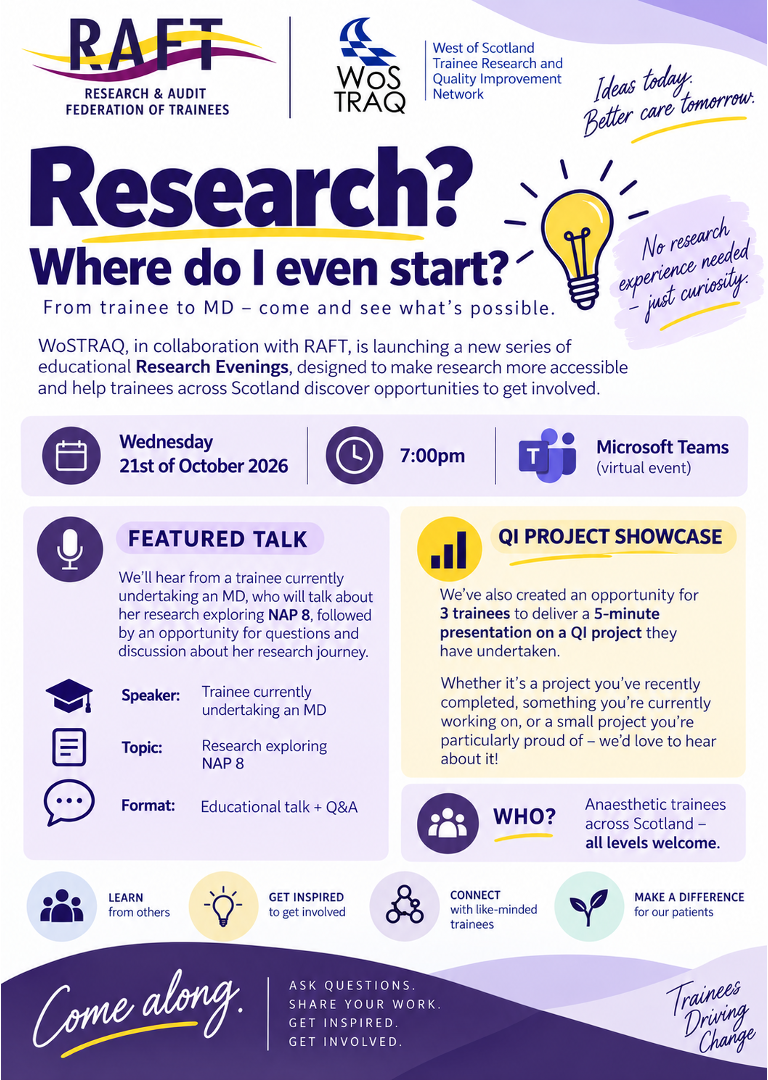
A new quarterly webinar series for anaesthetic trainees across Scotland, all levels welcome. The first evening is hosted by WoSTRAQ in collaboration with RAFT, featuring a trainee currently undertaking an MD talking about her research exploring NAP 8, followed by Q&A, plus short trainee presentations. Certificates of attendance are provided, linked to the RCoA Research & Managing Data, Safety & QI, and Education & Training domains. Further dates will be added here once confirmed.

Present your work (West of Scotland trainees): this time, presentation slots are open to West of Scotland trainees only, though everyone is welcome to attend. Send a brief abstract (under 250 words) to [email protected] for a 5-minute oral presentation plus 3 minutes of questions. Original research, QI and audit are all welcome, including previously presented work, and every presenter receives a certificate.

Meeting ID: 346 926 833 884 77 · Passcode: 72969363

Email an abstract (WoS trainees) Join on Teams Abstract deadline: 5pm, Friday 9th October
Poster: Research? Where do I even start? WoSTRAQ and RAFT research evening, 21 October 2026, 7pm, Microsoft Teams
Research day · Aberdeen

North-East of Scotland Anaesthesia & Critical Care Research Day

Friday 20th November 2026 · Suttie Centre, University of Aberdeen

A forum for anaesthetists at every career stage to showcase their work, hear about ongoing projects and build collaborations — delivered by the NHS Research Scotland Anaesthesia, Perioperative Medicine and Critical Care Specialty Group, NESSA and the Aberdeen Anaesthesia Research Network.

Event details Registration — coming soon
Course · Edinburgh

HealthyR: R for Health Data Science

Wednesday 9th – Friday 11th December 2026 · Edinburgh Futures Institute, 1 Lauriston Place

A 2.5-day quick-start course from the Usher Institute on using R to analyse health data — a great way to get to grips with the data side of an audit or research project. Suitable for complete beginners as well as those who want to build on existing R skills. Bring your own laptop.

£375 NHS/UoE staff · £275 students · £475 external

Details & booking Book by 2nd December — places often sell out

Previously — look out for next year

Annual · Every September

NRS Anaesthesia, Perioperative Medicine & Critical Care and SICSAG Conference

Golden Jubilee Conference Hotel, Clydebank

A joint two-day meeting. Day one, hosted by NHS Research Scotland, covers anaesthetic, perioperative and critical care research — breaking trial results, trial proposals and updates from trainee research networks. Day two, hosted by SICSAG, focuses on improving the quality of critical care, and includes the announcement of the SICSAG Quality Improvement Award.

SQuARes Net was there: our TRACE project (Theatre versus Room: A Comparison of haemorrhage Events) was presented by Dr Katie Turnbull.

Other ways to get involved

Research experience beyond local QI and audit
National scheme · NIHR

Associate Principal Investigator Scheme

A six-month, in-work training opportunity for anyone starting out in research. You work alongside the local Principal Investigator (PI) on an NIHR portfolio study at your own site, getting hands-on experience of how a multicentre study is actually delivered.

  • Mentored by the local PI for at least six months, working through a checklist of study activities and a learning pathway on NIHR Learn
  • Certified Associate PI status on completion, endorsed by the NIHR and Royal Colleges — a strong addition to your training portfolio
  • Open to doctors from FY1 upwards, plus nurses, midwives and AHPs; unfunded, so it runs alongside your usual clinical role
  • You'll need GCP training and your local PI's approval, and must register before you start — it can't be recognised retrospectively

Coming soon to SESSAWe're contacting PIs across the region to find out which anaesthetic and ICU studies are looking for an Associate PI. Interested? Get in touch and we'll match you up as studies come in.

Scotland-wide · Perioperative medicine

SPOMS projects

The Scottish Perioperative Medicine Society (SPOMS) brings together clinicians from every Scottish health board with a focus on perioperative education, audit and research.

  • A running list of national projects looking for collaborators
  • Trainee-led national audits — a straightforward way to get a multicentre project on your CV
  • Ideal if you're interested in preassessment, prehabilitation or shared decision making
Scotland-wide · Intensive care

SICSAG national ICU audit

The Scottish Intensive Care Society Audit Group (SICSAG) is part of Public Health Scotland's Scottish National Audit Programme, auditing the care and outcomes of ICU and HDU patients across Scotland.

  • National audit data, standards and annual reports — a great starting point for an ICU QI project
  • An annual SICSAG Quality Improvement Award, with the winner announced at the NRS/SICSAG conference each September

Higher degrees: getting started

MDs and PhDs in anaesthesia

Every anaesthetist engages with research to some degree — at minimum by using evidence-based guidelines and protocols, and by meeting the research requirements of ARCP and CCT. At the other end of the spectrum, some anaesthetists move into full-time academic roles and stop practising clinically. Most people sit somewhere in between.

This section is about the more intensive end of that spectrum: higher degrees, meaning MDs and PhDs. These take a significant time commitment on top of standard training, and compared with clinical training the academic pathway can feel fairly opaque — so here's a brief overview.

An MD is typically two years full-time equivalent, done alongside clinical work. A PhD is typically three years full time, and project or lab based. You don't need a Master's or an intercalated degree first, though many people who go on to a higher degree have done one — often as a way of testing their interest in research.

How to start thinking about it

Talk to as many people as possible. This is the single most useful thing you can do. Speak to people in clinical and academic roles, in anaesthesia and outside it, and at different career stages. Most people's view of research is shaped by their own route into it, so hearing from several gives you a much fuller picture.

These conversations also tell you what a supervisor or programme is actually like to work with — not just what's on paper — and put you on people's radar for future opportunities.

They rarely happen by chance. Expect to send cold emails and book time with people you don't know well. It will feel awkward at first; that's normal.

Before those meetings

  • Have a think about why research interests you, even if the answer isn't fully formed
  • Read a little about what the person works on — their general area, not their results
  • Have a rough sense of your timeline: exams, training milestones, life events, and how much flexibility you have
  • Understand how PhDs tend to be funded (below) — it shapes what applying looks like

How PhDs tend to be funded

Project-based studentships

A principal investigator has grant funding that includes a PhD post, advertised on sites like Find a PhD. You apply to work on a predefined project. Less common for clinicians, more common for scientists.

Upside:
you know roughly what you're signing up for
Downside:
less freedom to shape the project

Doctoral training programmes

A funder gives a university or other body money to run a structured programme (e.g. ECAT, Wellcome PhD fellowships, multimorbidity CDTs), usually advertised on university or NHS jobs boards. Often designed with clinicians in mind.

Upside:
salaries closer to clinical ones, a cohort for peer support, and help moving in and out of training and negotiating with TPDs and rota coordinators

Personal fellowships

You develop a project with a supervisor and write your own grant application to fund it. Generally seen as the most prestigious route, and a strong training experience in itself.

Best suits:
someone with an established supervisor relationship, a specific question and some pilot data
Downside:
most competitive, and more of the admin and logistics falls on you

There are other, less common arrangements. Some private hospitals fund an MD in exchange for on-call commitments, and some people self-fund a PhD. Self-funding is worth thinking through carefully: you're paying fees and losing clinical income at the same time, and part-time PhDs carry their own challenges alongside clinical training — so get advice from several people before going down that route.

Other useful resources

Talk to us

If you're thinking about a higher degree, or just want to talk it through, please get in touch — by email or in person. We're happy to answer questions, point you towards people worth speaking to, and talk about our own work too.

Get in touch

Committee

Who to contact

Get in touch

Questions, projects, getting involved, or website feedback

Starting a project, need advice on QI or audit methodology, or want to get involved in a national study — send us a note and the right committee member will get back to you.

This website is new, so feedback is very welcome. If you spot a broken link or an out-of-date project, or have an idea for something we should add, let us know.

Email
[email protected]

SESSA
South East Scotland School of Anaesthesia